
Summary Windsor’s manufacturing and tech sectors are highly automated, but heavy machinery still carries serious physical risks. Up-to-date first aid training is legally required and practically necessary to handle crush injuries, electrical burns, and cardiac events on the factory floor before EMS arrives.
Windsor is changing fast. We’ve always been Canada’s automotive capital, but if you look at the factory floors today, they look a lot more like high-tech laboratories. We are seeing massive investments in EV battery plants and highly automated assembly lines. But even with all these smart robots doing the heavy lifting, human workers are still the ones running the show. And where there are humans working alongside heavy machinery, accidents are bound to happen.That is exactly why enrolling your team in a local First Aid Course or exploring options for First Aid training Windsor is just as critical today as it was fifty years ago
It is easy to think that putting computers and robots on the floor makes everything perfectly safe. To some extent, it really does. But new technology brings its own unique set of hazards that managers need to prepare for.
- Why Do Modern Windsor Factories Still Have High Accident Risks?
Automation handles the repetitive, heavy tasks, but workers are still dealing with high-voltage equipment, massive robotic arms, and fast-moving conveyor systems.
A momentary lapse in concentration can lead to serious injuries. Crush injuries, deep lacerations, and severe falls are unfortunately still common in industrial settings. When a piece of heavy machinery malfunctions, the resulting injuries aren’t usually small scrapes. They are severe physical traumas that require immediate, confident action from the people standing closest to the accident.
- What Happens When Automation Fails?
Let’s say a worker is performing routine maintenance on an automated welding machine. The power isn’t fully isolated, and they suffer an electrical shock. Do your floor supervisors know what to do next?
If someone gets electrocuted or caught in a machine, the first few minutes dictate everything. Paramedics in Windsor are fantastic, but navigating a massive industrial park, getting through security, and making it onto the factory floor takes time. Your coworkers are the actual first responders. Knowing how to assess the scene safely without becoming a second victim is a massive part of Canadian Red Cross standard training.
- How Does First Aid Training Save Lives on the Floor?
Training goes way beyond putting on a band-aid. In a manufacturing environment, you need to know how to manage severe bleeding.
We teach workers how to apply tourniquets and manage deep wounds. If an employee suffers a laceration from a metal shear, applying correct, sustained pressure can literally keep them alive until the ambulance pulls up to the loading dock. It gives your team the muscle memory to step up and act instead of panicking.
- Are You Prepared for Sudden Cardiac Arrests?
Working in manufacturing is incredibly physically demanding. You add in rotating shift work, long hours on your feet, and the stress of hitting daily production quotas, and you have a recipe for cardiovascular issues.
If a worker collapses from sudden cardiac arrest near the assembly line, doing chest compressions immediately keeps oxygen flowing to their brain. Defibrillators (AEDs) are mandatory in most large facilities now, but having the machine hanging on the wall is completely useless if nobody feels confident opening the box. If you want to see exactly what industrial teams learn to handle these situations, you can check out https://www.c2cfirstaidaquatics.com/windsor-first-aid-cpr-training/ to review the core curriculum.
- What Makes Blended Learning Ideal for Shift Workers?
We get it. Pulling workers off the floor for two full days of training is a massive headache for production managers. Scheduling around day, afternoon, and midnight shifts feels like a puzzle you can’t win.
That is why Blended Learning is the perfect fit for industrial tech workplaces.
- Workers complete the theory modules online at home.
- They can pause and resume the material between shifts.
- They attend a single, shorter in-class session to practice physical skills.
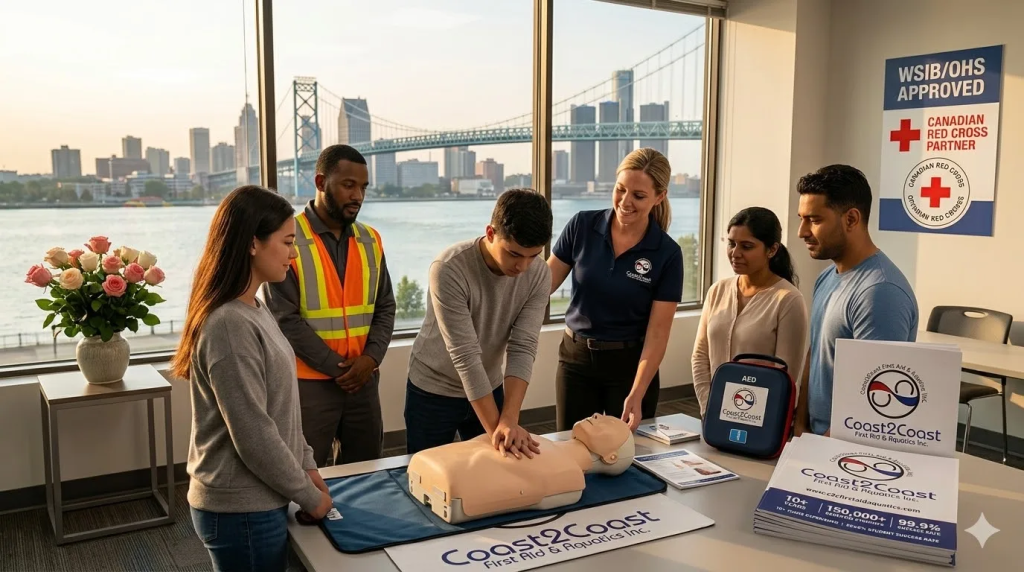
They get on the mats, practice their CPR, and learn how to wrap a wound. It meets all the strict WSIB and OHS guidelines required for Ontario workplaces, but it actually respects your demanding production schedule.
If you are looking for first aid training near Remington Park, the major crossroad of Howard Avenue and E.C. Row Expressway, or other areas close to our facility, then you may reach out to Coast2Coast First Aid/CPR – Windsor in that area. For more info and articles like this visit: https://www.c2cfirstaidaquatics.com/
- Frequently Asked Questions
Is WSIB first aid training mandatory for Windsor manufacturing facilities? Yes. Under the Workplace Safety and Insurance Board (WSIB) regulations in Ontario, all employers must ensure that first aid equipment, facilities, and trained personnel are available in the workplace at all times.
How many first aiders do I need on a factory floor? The exact number depends on how many workers you have on a given shift. Generally, workplaces with more than 5 workers on shift require at least one person with Standard First Aid certification. Large manufacturing plants often need multiple trained staff spread across different departments.
Can shift workers do first aid training completely online? No. While the theory portion can be done online through Blended Learning, the WSIB requires a hands-on, in-class session to evaluate practical skills like CPR compressions and wound bandaging.
What should an industrial first aid kit include? Kits should be fully stocked according to WSIB Regulation 1101. For heavy manufacturing, this usually means an assortment of sterile dressings, triangular bandages, splints, tourniquets, and personal protective equipment like gloves and pocket masks.
Does CPR training cover AED usage for factories? Yes. All recognized CPR and Standard First Aid courses include training on how to operate an Automated External Defibrillator (AED), which is critical for treating sudden cardiac arrests on the factory floor.