
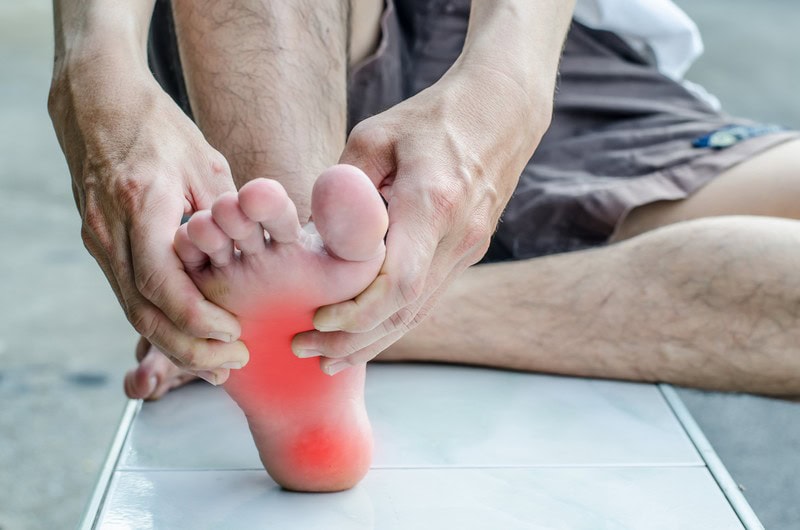
Why heel pain that lingers for six months rarely resolves with a single treatment — and what a coordinated plan actually involves.
Plantar fasciitis is one of the most common musculoskeletal complaints in Canadian primary care, affecting roughly 10 percent of adults at some point. It is also one of the most frustrating, because the typical recovery is slow even with appropriate treatment, and the conventional advice — rest, stretch, anti-inflammatories, maybe orthotics — leaves a meaningful portion of patients still in pain at six months. The chronic version is where most of the disability lives, and it is where single-discipline care most often falls short.
The condition is also commonly misunderstood. “Fasciitis” implies inflammation, but histological studies suggest chronic plantar fascia pain is more accurately a degenerative process — fasciopathy or fasciosis — in which the tissue fails to heal normally rather than being inflamed in the traditional sense. This distinction matters because it changes the treatment logic. The integrated approach in foot and lower-extremity care addresses the actual tissue problem alongside the biomechanical chain that is driving it.
What plantar fasciitis actually is
The plantar fascia is a thick band of connective tissue running from the heel bone to the base of the toes, forming the longitudinal arch of the foot. It functions as a passive support during standing and as a spring that stores and releases energy during walking and running. The tissue is well-designed for the loads of normal gait but becomes vulnerable when total load exceeds capacity over time.
Pain usually localizes to the medial calcaneus — the inside of the heel bone — and is classically worst with the first steps in the morning or after sitting. The pattern reflects the biomechanics: overnight or seated, the fascia contracts and any micro-injury heals in a shortened position. The first steps re-tear the healing tissue, producing the morning pain that resolves over the first 15 to 30 minutes of walking.
Risk factors include reduced ankle dorsiflexion, tight calf musculature, weak intrinsic foot muscles, sudden increases in running or walking volume, occupational standing, and footwear that does not match the patient’s foot mechanics. Body weight is a factor — heavier patients carry higher tensile loads through the fascia — but lean runners and walkers develop the condition too. Calgary patients often present after a winter of reduced activity followed by a spring ramp-up in walking, running, or hiking that exceeds tissue capacity.
Why a single-treatment approach often plateaus
Conventional treatment usually involves stretching, ice, anti-inflammatories, and sometimes orthotics. For acute, mild cases, this is often enough. For the patients who don’t improve in eight to twelve weeks, the issue is usually that the treatment addresses the symptom rather than the cause.
The plantar fascia rarely fails in isolation. The lower extremity is a kinetic chain, and dysfunction at the hip, knee, or ankle changes how load travels through the foot. A patient with limited ankle dorsiflexion compensates by overpronating the foot, which loads the medial fascia. A patient with weak hip abductors collapses the knee inward in gait, similarly increasing fascial strain. A patient with tight calves transfers stress directly to the fascial insertion at the heel.
Treatment that addresses only the foot — orthotics, plantar stretches, ice — leaves these upstream contributors in place. The fascia heals partially, then re-injures under the same load pattern, and the cycle continues. This is the typical chronic plantar fasciitis trajectory.
What an integrated assessment looks at
A useful assessment evaluates the entire lower extremity, not just the painful foot.
- Foot mechanics. Arch structure, intrinsic foot strength, toe mobility, and whether the foot pronates or supinates excessively in gait.
- Ankle range of motion. Specifically dorsiflexion, which influences foot mechanics directly. Less than 10 degrees is associated with higher plantar fascia load.
- Calf flexibility and strength. Both gastrocnemius and soleus, since each contributes differently to fascia loading.
- Knee alignment in single-leg loading. Knee collapse points to upstream weakness affecting the foot.
- Hip strength and control. Particularly hip abductors and external rotators that control lower-limb alignment.
- Footwear assessment. Current shoes, work shoes, and activity shoes. Worn-out shoes are a common, treatable contributor.
The findings inform a targeted plan. Two patients with identical heel pain may need quite different interventions depending on where the chain is failing.
The treatment layers that actually work
Manual therapy from a physiotherapist or chiropractor addresses tissue restrictions in the plantar fascia, the calf complex, and the ankle joint. Mobilization of restricted joints often improves dorsiflexion substantially within a few sessions, removing one of the major mechanical drivers. Soft-tissue work on the calves and the fascia itself helps the tissue tolerate the loading that rehabilitation will progressively add.
Targeted strengthening is the part most home programs underdose. Research strongly supports high-load slow-resistance training for the plantar fascia — typically heel raises on a step with a towel under the toes, performed slowly with progressive load. This is fundamentally different from light stretching and is more effective in research. The protocol takes 8 to 12 weeks but produces durable changes in tissue capacity. Intrinsic foot strengthening — short-foot exercises, toe spreading, single-leg balance work — restores the foot’s own load-bearing function.
Calf flexibility work, ankle mobility, and hip strengthening complete the picture. Patients often need only two or three exercises performed consistently rather than a long list performed occasionally.
Footwear, orthotics, and what to actually buy
Footwear is the single environmental variable most patients can change immediately. Shoes with adequate heel-to-toe transition, appropriate arch support for the individual foot, and replacement before they break down mechanically reduce daily load on the fascia. Cycling between two pairs is better than wearing one pair daily, because the cushioning recovers between uses.
Orthotics — over-the-counter or custom — can help in selected cases but are not universally beneficial. Research suggests they outperform placebo modestly for plantar fasciitis but do not change long-term outcomes substantially without the rest of the rehabilitation program. They are best understood as a load-management tool during recovery rather than a standalone cure. Patients with persistent symptoms beyond three months should consider a comprehensive foot assessment in Calgary rather than continuing to escalate the same single-strategy approach.
Other overuse injuries that share the same logic
Plantar fasciitis is one of a family of lower-limb overuse injuries that respond to the same integrated logic. Achilles tendinopathy presents with morning stiffness, pain with the first kilometres of a run, and thickening of the tendon, and it responds well to progressive heavy slow-resistance loading combined with calf and ankle mobility work. Patellar tendinopathy — jumper’s knee in volleyball players, runners, and skiers — follows a similar pattern with patellar tendon-specific exercises.
Iliotibial band syndrome, often misattributed to a tight IT band, is usually a hip strength and pelvic control problem treated through hip abductor and external rotator strengthening rather than aggressive foam rolling. Shin splints — medial tibial stress syndrome — typically involve load progression errors and intrinsic foot mechanics. Each of these injuries follows the same diagnostic and treatment logic: the painful tissue is rarely the original problem, and durable recovery requires addressing the chain that overloaded it. A clinic that handles all of these conditions under one roof gives Calgary recreational athletes a way to manage the inevitable overuse issues that come with active lifestyles rather than cycling through single-discipline providers.
When to consider injection or other interventions
Most plantar fasciitis resolves with conservative care within 6 to 12 months. For the persistent cases that haven’t responded after sustained rehabilitation, second-line interventions include extracorporeal shockwave therapy (which has reasonable evidence for chronic plantar fasciitis), platelet-rich plasma injection, and corticosteroid injection (which provides short-term relief but has potential downsides including risk of fascia rupture with repeated use).
These interventions work best as additions to ongoing rehabilitation rather than substitutes for it. A patient who gets an injection without addressing the biomechanical drivers usually returns within months. Patients with persistent or worsening symptoms should consult a qualified clinician to review the full plan rather than chasing single interventions in isolation.
The integrated payoff for chronic foot pain
Plantar fasciitis is fundamentally a load-capacity problem, and durable recovery requires increasing tissue capacity while addressing the chain of factors that overloaded it. The patients who get stuck in chronic recovery are usually the ones treating the foot in isolation rather than the system. Integrated care — manual therapy, progressive loading, biomechanical correction, and footwear management running in parallel — produces better outcomes than any single intervention in chronic cases.
Calgary’s outdoor culture means foot and lower-extremity overuse injuries are common, particularly in the spring ramp-up from winter to running, hiking, and walking. Patients with persistent heel pain or recurrent overuse injuries benefit from a coordinated assessment by a clinic with physiotherapy, chiropractic, and medical support in one place rather than running through providers sequentially.
About the author — this article was contributed by the team at Primaris Health, a Calgary multidisciplinary clinic with physiotherapists, chiropractors, and family physicians coordinating on musculoskeletal care. The clinic sees runners, walkers, hikers, and adults with chronic overuse injuries across the Calgary region.